بِسْمِ اللهِ الرَّحْمٰنِ الرَّحِيْمِ
السلام عليكم ورحمة الله وبركاته

AL - TAYYARAH Tours Pvt.Ltd
Information Of Jabal al-Thawr
(Ghar -e- Shor)
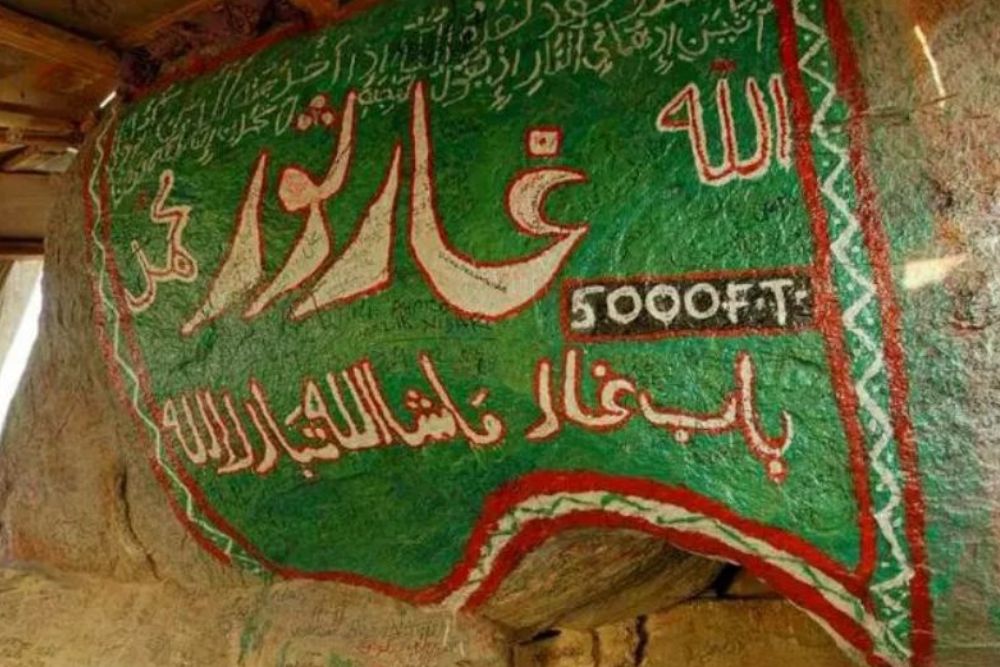
🕋 Jabal al-Thawr (The Mountain of Thawr)
Jabal al-Thawr (Arabic: جبل ثور) is the mountain that contains the famous cave where the Prophet Muhammad ﷺ and his closest companion, Abu Bakr (RA), took refuge for three days and nights while escaping from the Quraysh during the migration (Hijrah) from Makkah to Madinah.
Arriving at the Cave
When the Prophet ﷺ and Abu Bakr (RA) reached the cave of Thawr (Ghar al-Thawr), Abu Bakr (RA) entered first to make sure it was safe. He carefully checked the inside and blocked every small hole with pieces of his own cloth so nothing could harm the Prophet ﷺ. After that, the Prophet ﷺ entered and rested with his head on Abu Bakr’s (RA) lap.
At one point, something bit or stung Abu Bakr (RA) on his foot. Out of fear that the Prophet ﷺ might wake up, he remained still and endured the pain silently. The sting was so painful that tears fell from his eyes onto the Prophet’s ﷺ blessed face. The Prophet ﷺ woke up, saw his companion in distress, and gently applied his saliva to the wound, which instantly removed the pain.
Hiding in the Cave
The Prophet ﷺ and Abu Bakr (RA) stayed hidden in the cave for three days and nights. During this time, Abu Bakr’s son, Abdullah, spent his nights nearby. Each morning, he would secretly return to Makkah so no one would suspect him, and throughout the day he gathered news of the Quraysh’s plans. By nightfall, he would go back to inform the Prophet ﷺ and his father of the situation.
Meanwhile, Abu Bakr’s servant, Amir ibn Fuhayrah (RA), would graze his goats near the cave so that milk was available for the Prophet ﷺ and Abu Bakr (RA). He also cleverly led the herd along the same paths Abdullah took, so that any footprints were erased and the Quraysh would not be able to track them.
Allah’s Protection
During their stay, Allah ﷻ provided His protection. A spider spun its web across the cave’s entrance, and two doves settled nearby, making a nest and laying eggs. Later, a group of Quraysh trackers came searching in the area. They even reached the mouth of the cave. If they had only looked carefully inside, they could have seen the Prophet ﷺ and Abu Bakr (RA).
At that tense moment, Abu Bakr (RA) became extremely worried for the safety of the Prophet ﷺ. But the Prophet ﷺ reassured him, saying:
“Do not be sad. Allah is with us.”
When the Quraysh saw the spider’s web and the doves’ nest, they assumed no one could possibly be inside. Allah ﷻ describes this incident in the Qur’an, in Surah at-Tawbah (9:40):
“If you do not aid him, Allah has already aided him when the disbelievers drove him out. He was only one of two, when they were in the cave, and he said to his companion: ‘Do not grieve; indeed Allah is with us.’ Then Allah sent down His tranquility upon him and supported him with soldiers you did not see, and made the word of the disbelievers the lowest, while the word of Allah is the highest. And Allah is Exalted in Might and Wise.”
Leaving for Madinah
After three days, when they learned the Quraysh search had died down, the Prophet ﷺ and Abu Bakr (RA) left the cave and began their journey towards Yathrib (later known as Madinah).
At this point, Asma bint Abi Bakr (RA), the daughter of Abu Bakr (RA), brought them provisions for the road. She could not find anything to tie the food with, so she tore her waistband into two pieces—using one to secure the food and wearing the other. The Prophet ﷺ admired her quick thinking and gave her the honorable title “Dhat an-Nitaqayn” (the woman of the two waistbands). From then on, she was known by this name among the Muslims.
About the Cave Today
The entrance of the cave was originally much narrower. Around 800 AH (1858 CE), a man once got stuck while entering, and the opening had to be widened to free him.
Today, Jabal al-Thawr stands about 4 kilometers south of Makkah and remains a significant place in Islamic history, reminding Muslims of the Prophet’s ﷺ trust in Allah and the loyal companionship of Abu Bakr (RA).
🕋 Jabal Thawr Cave – FAQs
📍 Where is the Cave of Thawr located?
Jabal Thawr is a mountain in Saudi Arabia situated in the southern part of Makkah, near the Misfalah area. The cave is positioned within this mountain.
🌟 Why is the Cave of Thawr important?
The Cave of Thawr is regarded as a blessed and historic place because the Prophet Muhammad ﷺ and his companion Abu Bakr (RA) took refuge there for three days and nights during the migration (Hijrah) from Makkah to Madinah. To protect them from being discovered, Allah ﷻ caused a spider to spin a web over the cave’s entrance and doves to nest there, making it appear untouched. This divine protection prevented the Quraysh from finding them.
🚶 How can one reach the Cave of Thawr from Makkah?
The cave is located roughly 12 kilometers south of Makkah on Mount Thawr. It can be reached by road, followed by a steep climb up the mountain. From the top, visitors can enjoy a wide and beautiful view of Makkah’s landscape.
✨ What miracles took place in the Cave of Thawr?
Although the stay inside the cave was difficult, the Prophet ﷺ and Abu Bakr (RA) remained safe by Allah’s mercy. Among the miracles that occurred:
A spider spun a web over the cave’s entrance.
Doves nested near the opening.
The Quraysh searchers stood at the cave’s mouth but did not look inside, assuming no one could be there.
These events strengthened the believers’ faith in Allah’s help and protection.
🕌 How far is the Cave of Thawr from Madinah?
The distance between Jabal Thawr and Madinah is about 452 kilometers.
⏳ How old is the Cave of Thawr?
The exact age of the cave is not known. Since it is a naturally formed cave, it is believed to be several thousands of years old.
🕰️ How long did the Prophet Muhammad ﷺ and Abu Bakr (RA) remain in the cave?
According to Islamic scholars, they stayed in the cave for three days and three nights before resuming their journey to Madinah.
👥 Is the Cave of Thawr open to visitors?
Yes. Today, the cave is accessible to the public. Pilgrims and visitors often climb the mountain to see the cave and reflect on this important chapter of Islamic history.