بِسْمِ اللهِ الرَّحْمٰنِ الرَّحِيْمِ
السلام عليكم ورحمة الله وبركاته
AL - TAYYARAH Tours Pvt.Ltd
Information Of Masjid al Nabawi – History, Importance & Amazing Facts
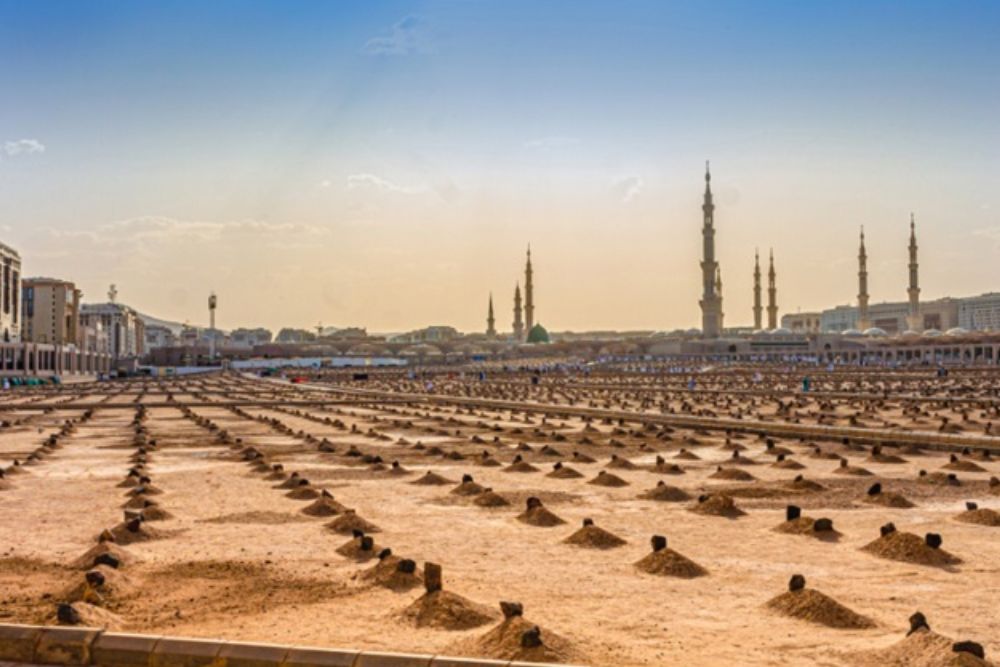
Jannatul Baqi – The Garden of Heaven
Jannatul Baqi (Arabic: جنة البقيع), also known as Baqi al-Gharqad, is the main cemetery of Madinah. It holds immense historical and spiritual significance in Islam, as it is the resting place of many of the Prophet Muhammad’s ﷺ family members, wives, companions, and prominent scholars.
The name Baqi refers to land filled with different tree roots, while Gharqad is a type of thorny tree (Boxthorn) that was once abundant there.
Historical Background
The first person buried in Al-Baqi was As’ad bin Zararah (RA), an Ansari companion who passed away shortly after the Prophet ﷺ migrated to Madinah.
The first of the Muhajirun (emigrants) to be buried there was Uthman bin Maz’oun (RA), shortly after the Battle of Badr.
Over time, it became the chosen cemetery for thousands of the Sahabah (companions) and righteous personalities.
The Prophet ﷺ himself frequently visited Al-Baqi. Aisha (RA) narrated that whenever the Prophet ﷺ spent the night with her, he would go towards the end of the night to Al-Baqi and supplicate for its residents. [Muslim]
Notable Personalities Buried in Jannatul Baqi
Family of the Prophet ﷺ
Aunts: Safiyyah bint Abdul Muttalib & Aatikah (RA).
Relatives: Abdullah bin Ja’far & Aqeel bin Abi Talib (RA).
Daughters: Fatima, Ruqayyah, Zainab & Umm Kulthum (RA).
Uncle: Abbas bin Abdul Muttalib (RA).
Grandchildren & descendants: Hasan bin Ali, Zainul Abideen, Muhammad al-Baqir, and Jafar as-Sadiq (RA).
Infant son: Ebrahim (RA), son of Prophet ﷺ and Maria al-Qibtiyya (RA).
Wives of the Prophet ﷺ (Mothers of the Believers)
Buried here are: Aisha, Hafsa, Sauda, Zainab bint Khuzaymah, Juwairiya, Umm Habibah, Safiyyah bint Huyayy, Zainab bint Jahash, and Umm Salamah (RA).
Not buried here: Khadijah (RA) – buried in Makkah, and Maymuna (RA) – buried in Sarif.
Companions (Sahabah)
Many companions are buried here, some in unmarked graves, including:
Sa’ad bin Abi Waqqas, Abdur-Rehman bin Auf, Abdullah bin Mas’ood, Abu Sufyan, Hakeem bin Hizam, Hassan bin Thabit, Ka’ab bin Malik, Ubai bin Ka’ab, Suhaib Rumi, Usama bin Zaid, Abu Saeed Khudri, and Sa’ad bin Mu’adh (RA).
Other Prominent Figures
Caliph Uthman ibn Affan (RA): The third Caliph of Islam.
Imam Malik (RA): The great scholar of Madinah, along with his teacher Imam Nafi’.
Haleemah Sa’diya (RA): The wet nurse of the Prophet ﷺ.
Martyrs of Harrah: Those who fought in the defense of Madinah in 683 CE.
Virtue of Jannatul Baqi
The Prophet ﷺ said:
“On the Day of Judgment, my grave shall be opened first, then Abu Bakr (RA), then Umar (RA). After that, I will proceed to Al-Baqi and take all its residents with me…” [Tirmidhi]
Visiting Jannatul Baqi is highly virtuous, especially on Fridays. It is recommended to convey salaam and make dua for its residents, asking Allah ﷻ to forgive them.
Demolition of Structures
Throughout history, domes and mausoleums were built over some graves in Al-Baqi. However, on 21 April 1925, King Abdul Aziz Al Saud ordered their demolition to prevent practices contrary to Islamic teachings, such as seeking help from the deceased.
FAQ on Jannatul Baqi
Q1: What does Jannatul Baqi mean?
It means “Garden of Heaven.” The word Baqi refers to land with many tree roots, and Gharqad refers to the boxthorn trees once common there.
Q2: Who was the first person buried in Jannatul Baqi?
The first was As’ad bin Zararah (RA), an Ansari companion.
Q3: Are the wives of the Prophet ﷺ buried in Jannatul Baqi?
Yes, most of them are buried there except Khadijah (RA) (buried in Makkah) and Maymuna (RA) (buried in Sarif).
Q4: Is Caliph Uthman (RA) buried in Jannatul Baqi?
Yes, Uthman ibn Affan (RA), the third Caliph and son-in-law of the Prophet ﷺ, is buried in Al-Baqi.
Q5: Can Muslims visit Jannatul Baqi today?
Yes, it is open to visitors, especially those performing Hajj or Umrah. It is Sunnah to visit, convey salaam, and make dua for the deceased.
Q6: Why were the domes and structures demolished?
In 1925, they were demolished to follow the Prophet’s ﷺ instruction of not building structures over graves and to prevent acts of grave worship.
Q7: Is it recommended to visit Jannatul Baqi on a specific day?
Yes, visiting on Friday is especially virtuous, though it can be visited at any time.